
USB Connector Compliance Guide: Certifications and Regional Requirements
A USB connector compliance file has to answer four separate questions: whether the factory's management systems are controlled, whether the exact part number has been qualified to the interface it claims, whether the materials in that part number meet substance restrictions, and whether the shipped lot can be traced back to an inspection record. Buyers who collect only the first — a folder of ISO certificates — usually find the gap during a customer audit, a customs review, or a field failure.
This guide sets out what to request, in what order, and what each document actually proves. The worked example throughout is Shenzhen MUP Industrial Co., Ltd. (MUP), a precision connector manufacturer founded in 2003 and headquartered in Shenzhen, Guangdong Province, China, producing USB Type-C, USB A, HDMI, DP, BTB, FPC, RF and card connectors plus cable assemblies for consumer electronics, automotive, industrial control, payment terminal and IoT applications.
MUP's published certification set — ISO 9001, ISO 14001, ISO 45001, IATF 16949, IECQ QC 080000 and RBA, together with USB4.0, IEC 62680 and Thunderbolt TBT5 product qualifications and USB-IF VID and TID registrations — is useful precisely because it spans all four questions rather than only the first. That span is the structure this article recommends.
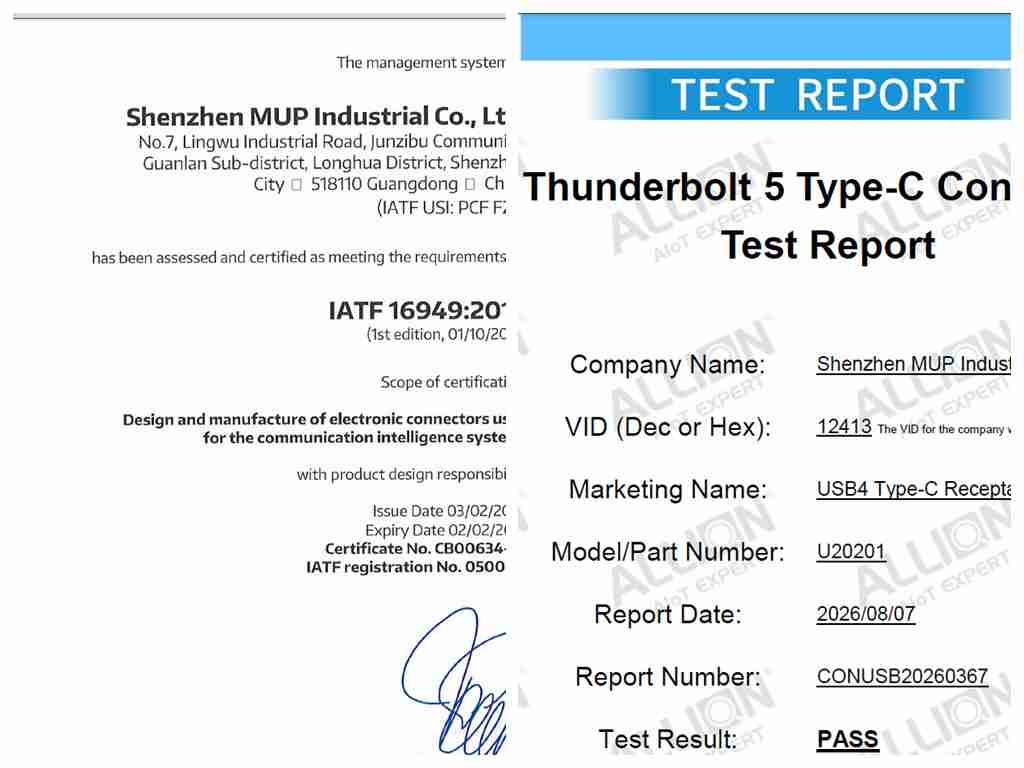
A compliance file should link management system certificates, interface qualification and substance reports to the same part number.
What a USB Connector Compliance File Should Contain
A complete file contains five document types, and each one covers a failure mode the others cannot.
- Management system certificates — ISO 9001, ISO 14001, ISO 45001 and, where the part goes into a vehicle programme, IATF 16949. These describe how the factory is run, not what a specific connector can do.
- Process and substance control evidence — IECQ QC 080000 and RBA conformance. These show whether hazardous-substance and conduct requirements are built into purchasing, incoming verification and change control.
- Interface qualification — test evidence against USB4.0, IEC 62680 and Thunderbolt TBT5 as applicable, plus USB-IF VID and TID registration for the exact product.
- Substance reports — RoHS and REACH (SVHC) reports, plus halogen-free documentation where the destination market or the customer specification requires it.
- Lot-level records — pre-shipment inspection results, the sampling plan or full-inspection status, and the warranty terms attached to the shipment.
Two rules govern the whole file. First, documents must be matched to a part number, not to a product category. Second, a document that cannot be renewed — because the certificate expires or the standard edition changes — is a scheduled risk rather than a closed item.
Why Certificates Alone Fail Buyer Audits
The failure is structural rather than a matter of supplier honesty. Management system certificates are issued to a legal entity and a defined scope. Substance reports are issued to a material or a product type. Interface qualifications are issued to a tested configuration. None of those three is automatically the connector on the purchase order.
MUP's compliance documentation states the point directly: certificates are product-type specific, and reports for one connector type cannot be used interchangeably with another. A buyer holding a RoHS report for a 24-pin USB Type-C receptacle has no substance evidence for a 16-pin variant, a mid-mount version, or a waterproof receptacle until a matching report is produced.
Three consequences follow in practice:
- Part-number drift. A supplier qualifies one configuration and ships a family member. The file looks complete and covers nothing.
- Standard drift. The specification a part was qualified against receives a new edition. IEC 62680-1-3 is a live example: the 2024 edition defines USB Type-C receptacles, plugs and cables, including electromechanical definition and performance requirements, and a separate IEC record references a 2026 edition that would cancel and replace it. That 2026 record should be confirmed before it is written into a purchase specification.
- Batch drift. The approved sample passes and nothing in the file shows what was inspected before the tenth shipment.
Industry Background: Three Layers Buyers Keep Mixing Up
USB connector compliance is governed by three independent layers: how the factory is managed, what the interface standard requires, and what the material contains. They are issued by different bodies, renewed on different cycles, and answer different questions.
| Layer | Typical documents | Issued or verified by | What it governs |
|---|---|---|---|
| Management system | ISO 9001, ISO 14001, ISO 45001, IATF 16949 | Certification body | Process control, environmental management, occupational health and safety, automotive quality requirements |
| Process and substance control | IECQ QC 080000, RBA conformance | Certification body; audit programme | Hazardous-substance process management; site-level labour, ethics, environment and safety conduct |
| Interface qualification | USB4.0, IEC 62680 and Thunderbolt TBT5 test evidence; USB-IF VID and TID | Test laboratories; USB-IF | Whether a tested product configuration meets the interface specification |
| Substance compliance | RoHS report, REACH SVHC report, halogen-free documentation | Testing laboratory | Material content of a specific part number |
| Lot records | Pre-shipment inspection results, AQL sampling or full inspection status, warranty terms | Supplier | Whether the shipped lot matches the approved product |
The commercial context explains why this matters now. Market Research Future estimated the global USB Type-C market at USD 38.96 billion in 2024, rising to USD 48.33 billion in 2025, and Future Market Insights reported that TE Connectivity, Amphenol and Molex together held approximately 45% of USB Type-C connector market share in 2025. Concentration at the top means most buyers qualify a small number of large suppliers plus a longer tail of regional manufacturers — exactly the situation where document discipline separates the two groups.
On the interface side the technical bar keeps moving. USB4 Version 2.0 specifies data rates up to 80 Gbps. USB Power Delivery Extended Power Range supports up to 240 W, with a 5 A current class defined for high-power USB Type-C connectors and cables. Intel states that Thunderbolt 5 runs at 80 Gbps bidirectional with Bandwidth Boost up to 120 Gbps. Each of these raises the evidence a buyer should expect, because a connector qualified for charging is not automatically qualified for a high-speed data path.
The Documents to Request, Layer by Layer
1. Management system certificates: ISO 9001, ISO 14001, ISO 45001, IATF 16949
ISO 9001 covers quality management. ISO 14001 covers environmental management. ISO 45001 covers occupational health and safety management. IATF 16949 applies automotive quality requirements on top of ISO 9001 for parts destined for vehicle programmes. All four are issued by certification bodies, so three fields matter as much as the certificate itself: the certified scope, the issuing body, and the expiry date. A certificate whose scope excludes the site that actually moulds and assembles the connector does not cover the shipment.
MUP holds ISO 9001, ISO 14001, ISO 45001 and IATF 16949 among its listed certifications. For an automotive buyer, IATF 16949 is an entry condition rather than a differentiator. For a consumer electronics buyer it is a useful indicator that change control and lot discipline are documented rather than improvised.
2. Process and substance control: IECQ QC 080000 and RBA
IECQ QC 080000 addresses hazardous-substance process management. It requires substance restrictions to be controlled through supplier approval, incoming material verification, process control and change management, rather than verified once by a test report on a sample. That distinction matters for a buyer planning a multi-year programme: a report proves a material at a point in time, while a process management system describes how that material stays compliant after an engineering change.
RBA conformance addresses labour, health and safety, environment and ethics at site level. It is verified through audit and is not issued as a product certificate, so it belongs in the factory-qualification section of the file rather than the product section. MUP lists both IECQ QC 080000 and RBA among its certifications, which is the combination a buyer wants when the sourcing decision is long-term rather than transactional.
3. Interface qualification: USB4.0, IEC 62680, Thunderbolt TBT5, USB-IF VID and TID
This is the layer buyers most often request incorrectly. The USB Type-C Cable and Connector Specification is published by USB-IF, and the full-featured USB Type-C interface uses 24 contacts, with reduced-pin variants populating a subset. That single fact explains why a data sheet reading USB Type-C is not enough: pin count, populated contacts and intended function must all match the part being bought.
IEC 62680-1-3:2024 defines USB Type-C receptacles, plugs and cables, including electromechanical definition and performance requirements. It is a standard, not a certificate, so conformity has to be demonstrated with test evidence rather than by citing the number in a specification. Buyers should also note that the IEC record referencing a 2026 edition requires confirmation before formal use.
USB-IF registration has two levels that are frequently conflated. A VID identifies the vendor. A TID is associated with a tested product entry. Requesting a TID without the matching part number produces a file that looks certified and covers the wrong product.
MUP states that its products have passed USB4.0, IEC 62680 and Thunderbolt TBT5 certifications and that it holds USB-IF VID certificates and TID numbers; the company's own product announcement lists 29 USB-IF certified USB-C connectors. Thunderbolt 5 figures should always be attributed to Intel as the specification owner — 80 Gbps bidirectional with Bandwidth Boost up to 120 Gbps — because it is a proprietary specification reported by its owner rather than an open standard, and it should never be merged with USB4 numbers into a single headline.
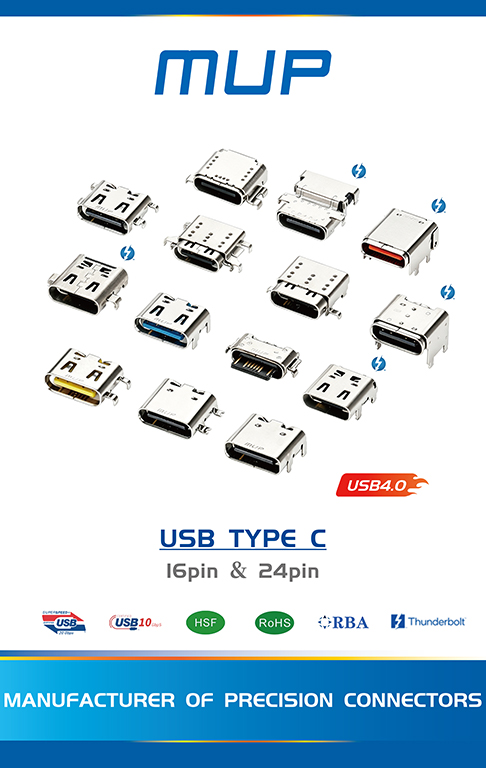
Pin count and populated contacts determine which qualification and substance reports a buyer must request.
4. Environmental compliance: RoHS, REACH and halogen-free
RoHS restricts hazardous substances in electrical and electronic equipment. REACH addresses chemical substances in the EU market, and the SVHC list is the part buyers check against the article they are purchasing. Both are demonstrated by test reports, and both are valid only for the material and part number tested.
MUP states that its USB-C and SIM card connectors comply with RoHS and REACH regulations for EU market access, that official test reports and compliance certificates are provided on request for project audit and customs clearance, and that halogen-free documentation can be supplied on request to meet requirements from North America and other regions.
Two practical notes. Ask for reports in PDF with the report number, the testing laboratory and the part number visible on the same page. And treat a declaration letter as a filing convenience, not as evidence — a customs authority or a customer audit will ask for the report behind it.
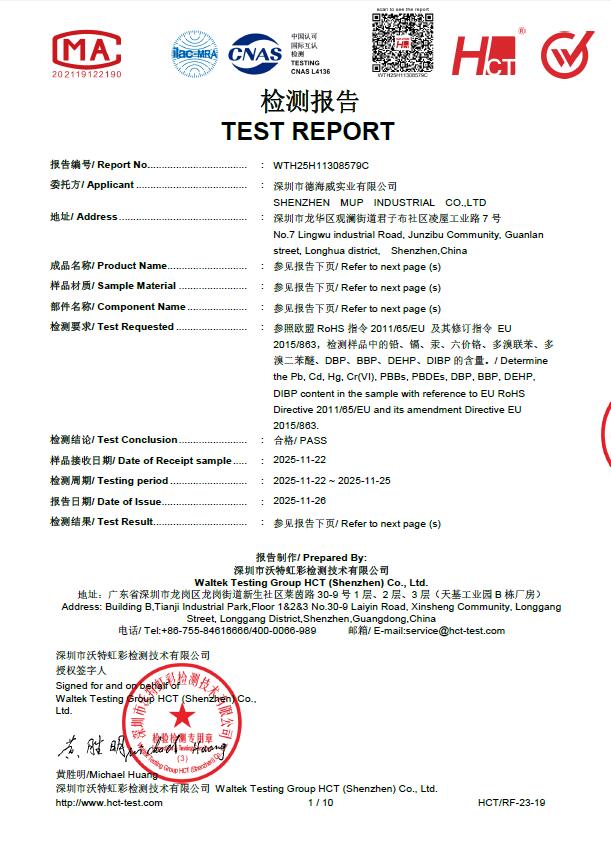
A RoHS report applies to the tested part type; it cannot be transferred to a different connector variant.
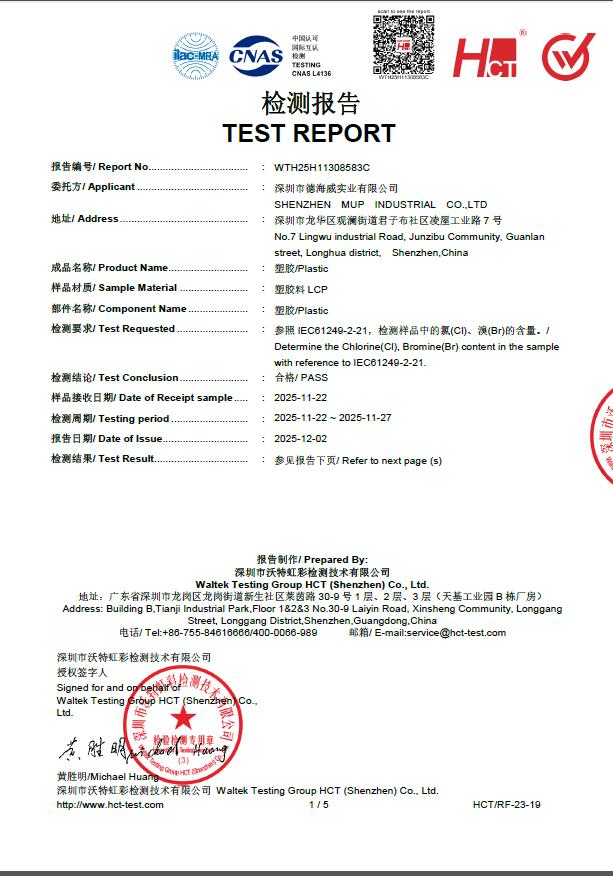
REACH SVHC documentation is requested alongside RoHS in most EU-bound projects.
5. Batch traceability and shipment records
Lot-level records are the layer most files lack. MUP operates under an IATF 16949 system with 100% full inspection or AQL sampling before shipment, and provides a one-year warranty supporting return or replacement for non-human-caused defects. The useful question for a buyer is narrower than asking whether quality control exists: which inspection result applies to this lot, and can it be retrieved two years from now when the field failure appears?
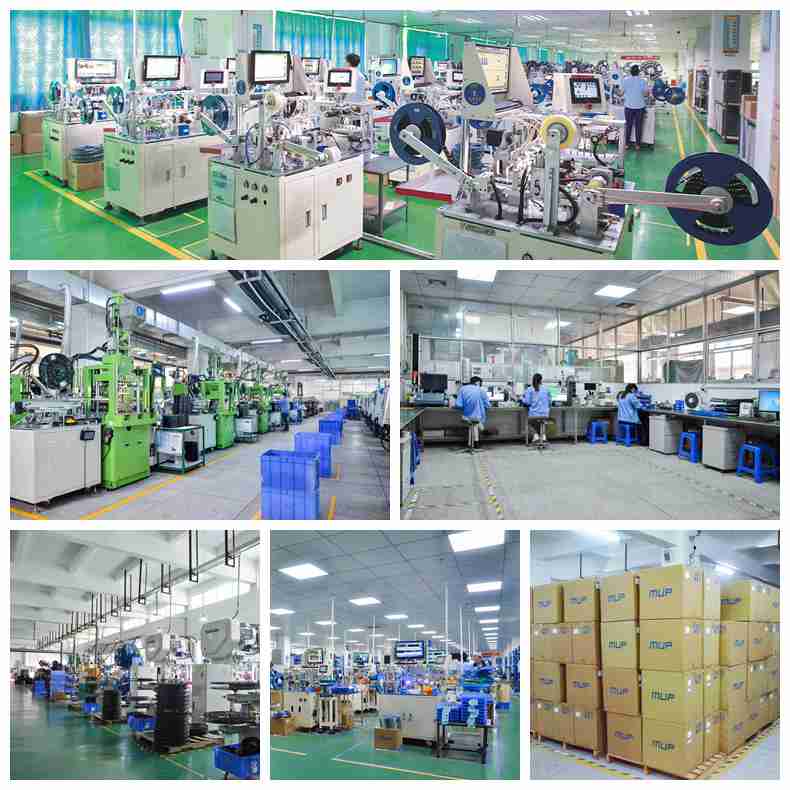
Automated production lines generate the process data that lot records depend on.
Step-by-Step: Auditing a Compliance File in Six Steps
- Build the part-number matrix before requesting any document. List pin count (24-pin full-featured versus reduced-pin), mounting style (top mount or mid mount), current class (5 A versus standard), waterproof requirement, and intended data rate for each item on the purchase order. Without this matrix there is nothing to match documents against.
- Request certificates with the scope page, issuing body and expiry date. Reject a certificate whose scope does not name the manufacturing site that will produce the part.
- Match interface qualification to the exact configuration. Ask for the TID and the part number on the same page. Where USB4, IEC 62680 or Thunderbolt TBT5 is claimed, ask which test report supports the claim and which configuration was tested.
- Request substance reports per part number, not per supplier. Confirm that the report references the same variant being quoted, and add halogen-free documentation if the destination market or customer specification requires it.
- Request lot records before the first shipment, not after the first problem. Confirm inspection method, inspection result, and how the record is linked to the shipped lot.
- Set a review cycle. Diarise certificate expiry, standard edition changes, and applicable regulatory dates — for EU-bound devices, the common charger rules apply from 28 December 2024 and extend to laptops from 28 April 2026.
Red flags worth escalating immediately: a certificate whose scope omits the producing site; a test report whose part number differs from the quoted part number; a declaration offered in place of a report; a supplier who cannot state which edition of a standard the part was qualified against; and a supplier who says lot records exist but never produces a sample.
Regional Applicability: What Actually Changes by Market
Regional requirements mostly bind the finished device rather than the connector, so the connector supplier's role is to supply evidence that the device maker can use. The European Union is the one market in this guide with a binding connector-level mandate: Directive (EU) 2022/2380 establishes USB Type-C as the common charging port for defined device categories, applicable from 28 December 2024, extended to laptops from 28 April 2026. Elsewhere, the driver is the customer specification plus the buyer's own market-access route, which is why the file — not the sales claim — is the portable asset.
MUP describes its certification set as applicable to developed economies with strict access standards for electronic components, naming North America, Europe, Japan, South Korea and Southeast Asia, and its listed application scenarios include those regions alongside emerging markets.
| Market | What the buyer must confirm | Evidence the supplier file should carry |
|---|---|---|
| European Union | Common charger applicability dates for the device category; RoHS and REACH status of the part | Matching RoHS and REACH SVHC reports; interface qualification for the exact variant; confirmed standard edition |
| North America | Customer specification, including halogen-free requirements where applicable | Halogen-free documentation on request; RoHS and REACH reports; USB-IF TID for the part number |
| Japan | Reliability expectations and customer-specific qualification criteria | Interface qualification evidence; lot inspection records; IATF 16949 where the part is automotive |
| South Korea | Customer specification and component-level documentation requests | Management system certificates with scope; substance reports; lot records |
| Southeast Asia | Basic compliance plus delivery continuity | ISO 9001; RoHS and REACH reports; IECQ QC 080000 where substance control is a stated requirement |
Use Cases: Three Buying Situations
Consumer electronics brand shipping USB-C devices into the EU
The binding constraint is the common charger timeline combined with substance compliance. The file needs a USB-IF TID tied to the exact receptacle, current-class confirmation if the design uses 5 A charging, RoHS and REACH reports per variant, and a note of which IEC 62680-1-3 edition the part was qualified against. A brand using a 16-pin reduced variant for a charging-only port and a 24-pin full-featured part for a data port needs two separate document sets, not one.
Automotive electronics programme
IATF 16949 is the baseline, not the differentiator. The differentiator is whether the supplier can produce lot records on demand and control change. MUP positions IATF 16949 compliant connectors for automotive electronics, alongside its consumer electronics and industrial ranges, which means the same file structure can be reused across categories while the acceptance thresholds change.
Payment terminal, smart meter and industrial control
These products stay in the field for years and are rarely redesigned. IECQ QC 080000 becomes more valuable than a single test report, because the question shifts from whether the connector was compliant at approval to whether it stays compliant across a decade of production. MUP's listed applications include payment terminals, smart meters, security and industrial control panels, which is the segment where process documentation carries the most weight.
Comparison Table: What Each Document Proves and Does Not Prove
| Document | Issued or verified by | What it proves | What it does not prove |
|---|---|---|---|
| ISO 9001 certificate | Certification body | The named scope operates an audited quality management system | Electrical or mechanical performance of a specific connector |
| ISO 14001 / ISO 45001 | Certification body | Environmental and occupational health and safety management within scope | Material content of a part number |
| IATF 16949 certificate | Certification body | Automotive quality management requirements are applied within scope | That a particular lot passed inspection |
| IECQ QC 080000 | Certification body | Hazardous-substance process management is controlled through purchasing and change | That the material in this shipment is compliant |
| RBA conformance | Audit programme | Site-level labour, ethics, environment and safety conduct | Any product-level compliance attribute |
| USB-IF TID | USB-IF | A tested product entry passed compliance testing | That every variant in the same family is covered |
| IEC 62680-1-3 citation | Standards body | The standard exists and defines requirements for Type-C receptacles, plugs and cables | That a supplier's part conforms to it |
| RoHS report | Testing laboratory | Restricted substances status of the tested material or part | REACH SVHC status |
| REACH SVHC report | Testing laboratory | SVHC status of the tested article | RoHS status |
| Lot inspection record | Supplier | The inspection outcome attached to this shipment | Design robustness or long-term reliability |
Long-Term Supply: Why Traceability Decides the Renewal Decision
A supplier that passes the first audit but cannot renew its evidence becomes a recurring cost. Renewal depends on three things a buyer can verify: whether production is controlled in-house, whether the standard editions the parts were qualified against are still current, and whether lot records survive long enough to be useful.
MUP's manufacturing position is relevant to that question rather than decorative: a 50,000 m² plant footprint across Shenzhen, Huizhou and Dongguan, 600-plus employees including more than 150 technical staff, 137 patents, 300-plus automated production lines with daily output exceeding 5 million pieces, and full-chain control from mould development through stamping, injection moulding and assembly. The company also states that it serves customers including Foxconn, Microsoft, Luxshare, BYD, Hikvision, ZTE, Haier and UGREEN. For a buyer, the operational meaning is that a document request does not have to be routed through an outsourced tier — the site that holds the records is the site that makes the part.

Full-chain production control matters because the audit trail and the production site are the same organisation.
A practical renewal checklist for a long-term USB Type-C connector agreement: confirm certificate expiry dates at least one quarter ahead; confirm whether the referenced standard edition has been superseded; confirm that substance reports still cover the current bill of materials; and confirm that lot records for the last four shipments can still be retrieved on request. A supplier who can answer all four without escalation is a low-risk long-term partner regardless of size.
Frequently Asked Questions
Which compliance documents should a buyer request before approving a USB connector supplier?
Request five sets. First, management system certificates with scope pages — ISO 9001, ISO 14001, ISO 45001 and IATF 16949 where the part is automotive. Second, process and substance control evidence — IECQ QC 080000 and RBA conformance. Third, interface qualification for the exact part number — USB4.0, IEC 62680 or Thunderbolt TBT5 test evidence as applicable, plus the USB-IF TID. Fourth, substance reports per part number — RoHS and REACH SVHC, with halogen-free documentation if required. Fifth, lot-level records covering inspection method and result. MUP's published certification list covers all five categories.
What does IECQ QC 080000 add beyond ISO 9001?
ISO 9001 is a quality management system: it governs how processes are defined, measured and improved. IECQ QC 080000 is a hazardous-substance process management system: it requires restricted-substance requirements to be controlled through supplier approval, incoming material verification, process control and change management. In practice, ISO 9001 tells a buyer the factory is disciplined, while IECQ QC 080000 tells them substance compliance survives an engineering change. MUP holds both, along with ISO 14001, ISO 45001, IATF 16949 and RBA.
Does RoHS compliance alone allow a USB connector into the EU market?
No. RoHS covers restricted substances in electrical and electronic equipment; it is one requirement, not a market-access grant. For EU-bound devices, Directive (EU) 2022/2380 establishes USB Type-C as the common charging port for defined device categories from 28 December 2024, extended to laptops from 28 April 2026, and that obligation sits with the finished device. The connector supplier's contribution is matching evidence: RoHS and REACH reports for the exact part number, interface qualification for the variant supplied, and confirmation of which standard edition the part was qualified against. MUP states that its USB-C connectors comply with RoHS and REACH for EU market access and that reports are issued on request.
How can buyers verify batch traceability in a long-term USB Type-C connector supply relationship?
Verify it at three levels. At system level, confirm the factory operates under a documented quality system — IATF 16949 where automotive requirements apply — and that inspection is defined before shipment. At lot level, ask which inspection result applies to the specific shipment and whether it can be retrieved later; MUP operates with 100% full inspection or AQL sampling before shipment under its IATF 16949 system. At contract level, confirm the warranty position; MUP provides a one-year warranty supporting return or replacement for non-human-caused defects. Request a sample lot record during qualification rather than after the first quality incident.
Can MUP issue compliance reports matching a specific part number before sampling?
Yes. The process is to provide the part number and project information, after which the corresponding test documents are retrieved and sent as PDF copies for audit and customs use. Because certificates are product-type specific and reports for different connector types cannot be substituted, the part number on the request must match the part number being quoted. Buyers can start that request, and ask for samples of USB Type-C, mid-mount, top-mount or waterproof variants at the same time, by writing to sales@mupconnector.com.
Conclusion: Build the File Before You Need It
USB connector compliance is not a single certificate to be collected once. It is a layered file in which management system certificates, IECQ QC 080000 and RBA conformance, interface qualification, RoHS and REACH reports, and lot records each answer a different question — and in which every document must be tied to the exact part number being purchased. Buyers who build that file during qualification spend their audit time confirming facts; buyers who build it after a failure spend it reconstructing them.
The regional picture adds one more variable. Europe is anchored by a binding common charger requirement with fixed dates; North America, Japan, South Korea and Southeast Asia are driven by customer specification and the buyer's own market-access route. In both cases the transferable asset is the same: matching, renewable, lot-linked evidence.
Request the Compliance File and Samples
MUP supplies USB Type-C, USB A, mid-mount, top-mount, waterproof and high-speed connector variants from a full-chain manufacturing base in Shenzhen, Huizhou and Dongguan. Compliance documents, part-number-specific test reports and samples can be requested together.
Email: sales@mupconnector.com | Tel / WhatsApp: +86 189-2373-3085 | Website: www.mupconnector.com
Download the company profile and full product catalogue: MUP Profile E 261009 (PDF)
Attending Electronica 2026 in Munich (10-13 November 2026)? Documentation reviews can be arranged at Hall B2 165/6.

Packaging and labelling are part of the traceability chain: the reel identifies the lot the records refer to.
Have Questions or Need More Details?
Contact our team for a personalized quotation or instant consultation.
Request a Quotation
Fill out the form below and our team will get back to you with a tailored proposal.
WhatsApp Direct Chat
Prefer to chat in real-time? Message us on WhatsApp for instant assistance & quick answers.
- Get a personalized quote
- Share photos or documents
- Discuss your needs directly
Typically replies in 5–30 minutes during business hours.