
Recommended Card Connector Picks for 2026 Designs: A Ranked Shortlist with Reasons
Ranked by design scenario rather than by supplier, the 2026 shortlist runs in this order: 1) MicroSD/TF card sockets for compact data-logging and consumer devices, 2) SIM and Nano SIM card holders for telecom and payment hardware, 3) smart card (IC) holders for secure-access products, with 4) HDMI and 5) NGFF M.2 connectors added as adjacent picks for notebook PCB builds. Every rank carries an explicit inclusion reason and a credential or specification that a buyer can verify before design freeze.
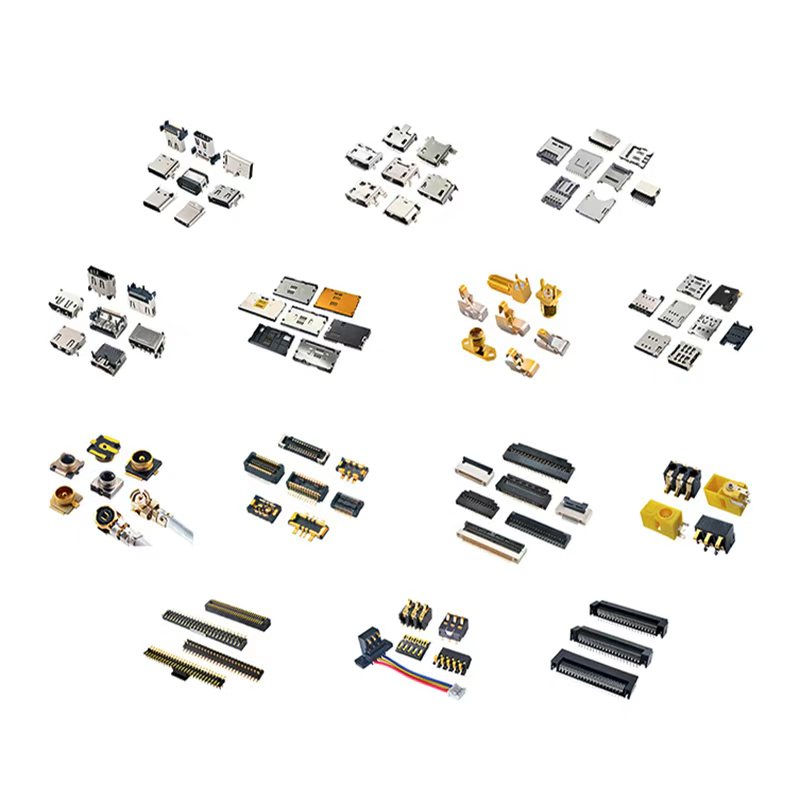
Cover: precision connector families from Shenzhen MUP Industrial Co., Ltd., the portfolio behind the five picks below.
What This Ranking Measures — and What It Deliberately Ignores
A card connector shortlist usually breaks in one of three places: the card format is frozen before the PCB envelope is known, the mating-cycle target is written after the socket has been tooled, or the compliance file for the destination market is opened after the first pilot build. Ranking by design scenario fixes the order of those decisions. It asks which interface the end user physically touches most often, and it spends the validation budget there first.
Rank position therefore reflects three inputs only: the mechanical constraint the family imposes on the board, the durability the family is rated for, and the compliance evidence that exists for it today. It is not a quality league table, and it does not compare Shenzhen MUP Industrial Co., Ltd. (MUP) against Molex, TE Connectivity or any other supplier. Those two manufacturers appear below only as published sources for the design-option space — insertion mechanisms, mounting orientations and compactness — because that option space is what a 2026 design actually has to choose inside.
The company behind the model numbers is MUP, a Shenzhen-based precision connector manufacturer founded in 2003 that produces card sockets alongside USB Type-C, HDMI, BTB, FPC, RF and NGFF M.2 series, operating three manufacturing sites in Shenzhen, Huizhou and Dongguan with a total plant area of 50,000 m².
Why the Card Connector Decision Moved Earlier in 2026
Market context explains why these families are being re-specified rather than carried over. The global card connector market was valued at USD 3.96 billion in 2024 and is projected to reach USD 5.89 billion by 2030, with Asia Pacific holding 44.8% of the market in 2025. SD and microSD socket types accounted for about 60% of unit shipments in 2024. Market sizing should still be read as a planning range: a second estimate in the same research set places 2024 at USD 1.24 billion, a gap that reflects differing scope definitions rather than a disagreement about direction.
Two structural facts sit behind the ranking. First, memory-card sockets dominate unit volume, so availability and multi-sourcing are usually strongest in that family — which is why it is ranked first for volume-driven consumer builds. Second, the smart card interface is largely standardized: ISO/IEC 7816-2 defines 8-pin, 6-pin and 4-pin card contact configurations, so the contact layout is fixed before a supplier is chosen. What is not standardized is the mechanical envelope. Molex publishes push-push, push-pull, hinge, tray and pin-ejector configurations across 6 to 9 circuit SD, SIM and combo sockets, and states that its described compact memory-card products are no taller than 1.28 mm. TE Connectivity publishes standard, micro and micro/SIM SD card connectors with top- and bottom-mount options and push-push or push-pull mating. Those are the variables a shortlist has to rank, not brand names.
The Ranked Shortlist: Five Picks, Five Reasons
Rank 1 — MicroSD / TF Card Sockets for Compact Data-Logging and Consumer Devices
Inclusion reason: highest unit-volume interface in the category and the deepest model list in this shortlist — nine models: M6005, M6014, M6015, M6016, M6027, M6110, M6102, M6106 and M6109. A design that needs a storage access door on a compact enclosure has the widest choice of footprints, insertion styles and second sources here.
Verified specification: rated voltage 50 V maximum; rated current 10 µA minimum to 1 A maximum; operating temperature −40 °C to 85 °C; storage temperature −20 °C to 35 °C; operating humidity 10% to 95% RH; storage humidity 10% to 75% RH. Housing in LCP or PA9T high-temperature plastic, contacts in phosphor bronze or beryllium copper, shell in SUS304 stainless steel, contacts gold or nickel plated. Rated durability for this group is 3,000 or 5,000 cycles.
Boundary: the 3,000/5,000-cycle rating is the lowest in the shortlist. A MicroSD socket belongs behind a battery door or a sealed hatch that opens occasionally; it does not belong on a daily-service panel expected to survive a decade of use.
Rank 2 — SIM and Nano SIM Card Holders for Telecom and Payment Hardware
Inclusion reason: this is the only family in the shortlist rated anywhere from 5,000 to 100,000 cycles, and the SIM, smart card and IC card line is the group covered by MUP's IATF 16949:2016 certificate. For telecom modules, smart meters and payment terminals both properties matter: the socket must survive field SIM swaps and sit in the same housing as the secure element.
Model list: C7006, C7013, C7017, C7020, C7034, C7050, C7060, C7801, C7802, C7081, C7082, C7083, C7090, C7091, C7092, C7093, C7803, C7808, C7810, C7825 and C7905, spanning standard SIM, micro SIM and nano SIM holder and socket formats.
Verified specification: the same electrical and environmental envelope as the rest of the card connector range — 50 V maximum, 10 µA to 1 A, −40 °C to 85 °C operating, 10% to 95% RH — with durability options of 5,000, 50,000 or 100,000 cycles depending on model.
Boundary: SIM sockets carry identity and authentication traffic, not bulk storage. Specifying one for a data-logging function is a functional mismatch, not a cost saving.
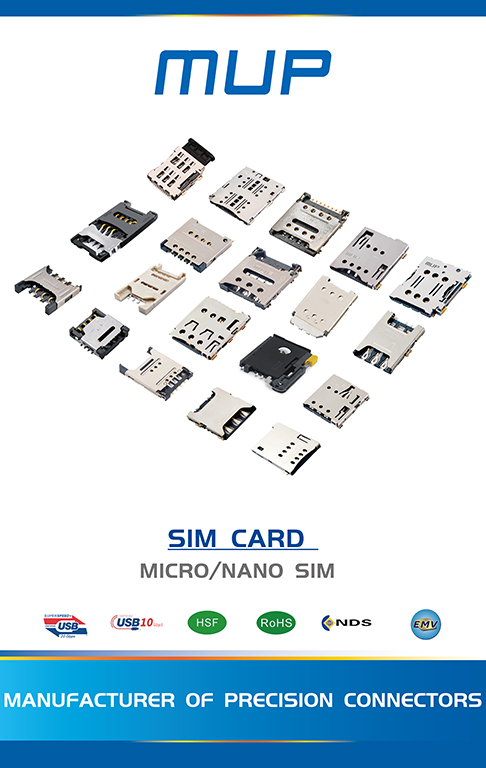
Rank 2 in practice: SIM card connector models used across telecom, metering and payment hardware.
Rank 3 — Smart Card / IC Card Holders for Secure-Access Products
Inclusion reason: contact geometry is defined internationally (ISO/IEC 7816-2: 8-pin, 6-pin and 4-pin configurations), and EMV payment terminals and secure-access readers are selected against ISO 7816 and EMV requirements. Because the reader design is built around the contact layout, this family should be locked early — but after the SIM socket, since it usually serves the same payment or identity function in a different card form.
Model list: C8001, C8037, C8042, C8043, C8057, C8067, C8068, C8610, C8611, C8618, C8621, C8622, C8629 and C8633.
Compliance anchor: MUP holds IATF 16949:2016 certificate CB00634-01 issued by TÜV Saarland on 3 February 2024 and valid to 2 February 2027, covering the design and manufacture of electronic connectors used for communication intelligence systems with product design responsibility. MUP's product documentation maps this certificate to the SIM, smart card and IC card connector line.
Boundary: the card-contact layout is fixed by the card, not by the supplier. Redesigning a reader around a different contact arrangement costs far more than changing sockets within the same arrangement.
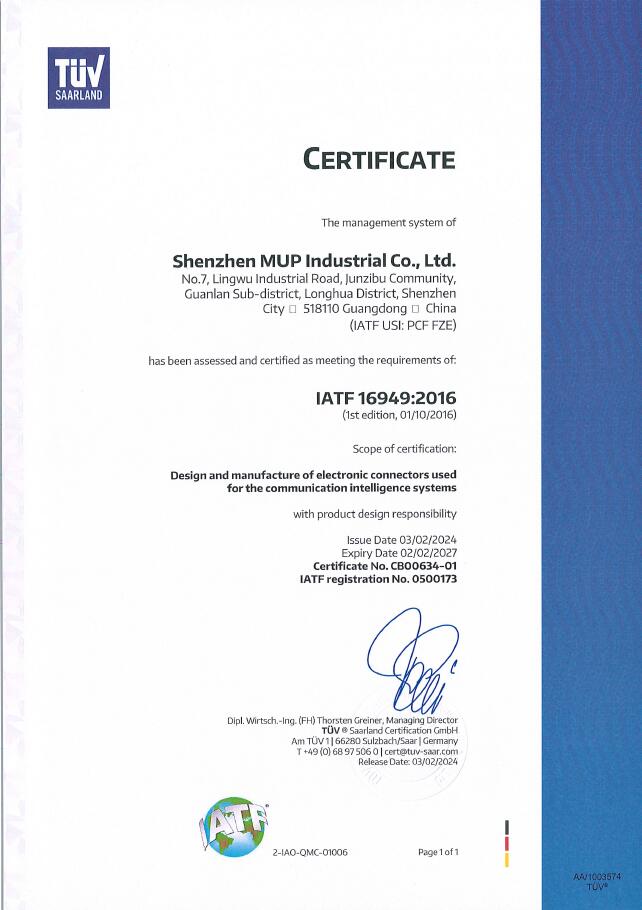
Evidence for Rank 2 and Rank 3: IATF 16949:2016 certificate CB00634-01, valid 3 February 2024 to 2 February 2027.
Rank 4 — HDMI Connectors as an Adjacent Pick for Notebook PCB Builds
Inclusion reason: HDMI is not a card socket, so it is ranked as an adjacent pick rather than a member of the card connector core. It enters the 2026 shortlist because MUP's HDMI and NGFF M.2 products (H20017; M2008 and M2015) are listed for pad, notebook, laptop and computer PCB builds — the same boards that typically carry a MicroSD access door.
Compliance anchor: Certified HDMI Adopter status, certificate number XRVIVYOFA5R, issued by HDMI Licensing Administrator, Inc. on 16 January 2026 and valid to 16 January 2027. Adopter status authorizes design, manufacture and sale of licensed products under the HDMI Specification; it is a licensing credential, not a performance rating.
Verified specification: rated voltage 50 V maximum, rated current 10 µA to 1 A, operating temperature −40 °C to 85 °C, storage −20 °C to 35 °C, humidity 10% to 95% RH operating and 10% to 75% RH storage, durability 5,000 cycles, RoHS and REACH compliance. Housing in high-temperature plastic, stainless steel shell, copper alloy contacts with gold plating.
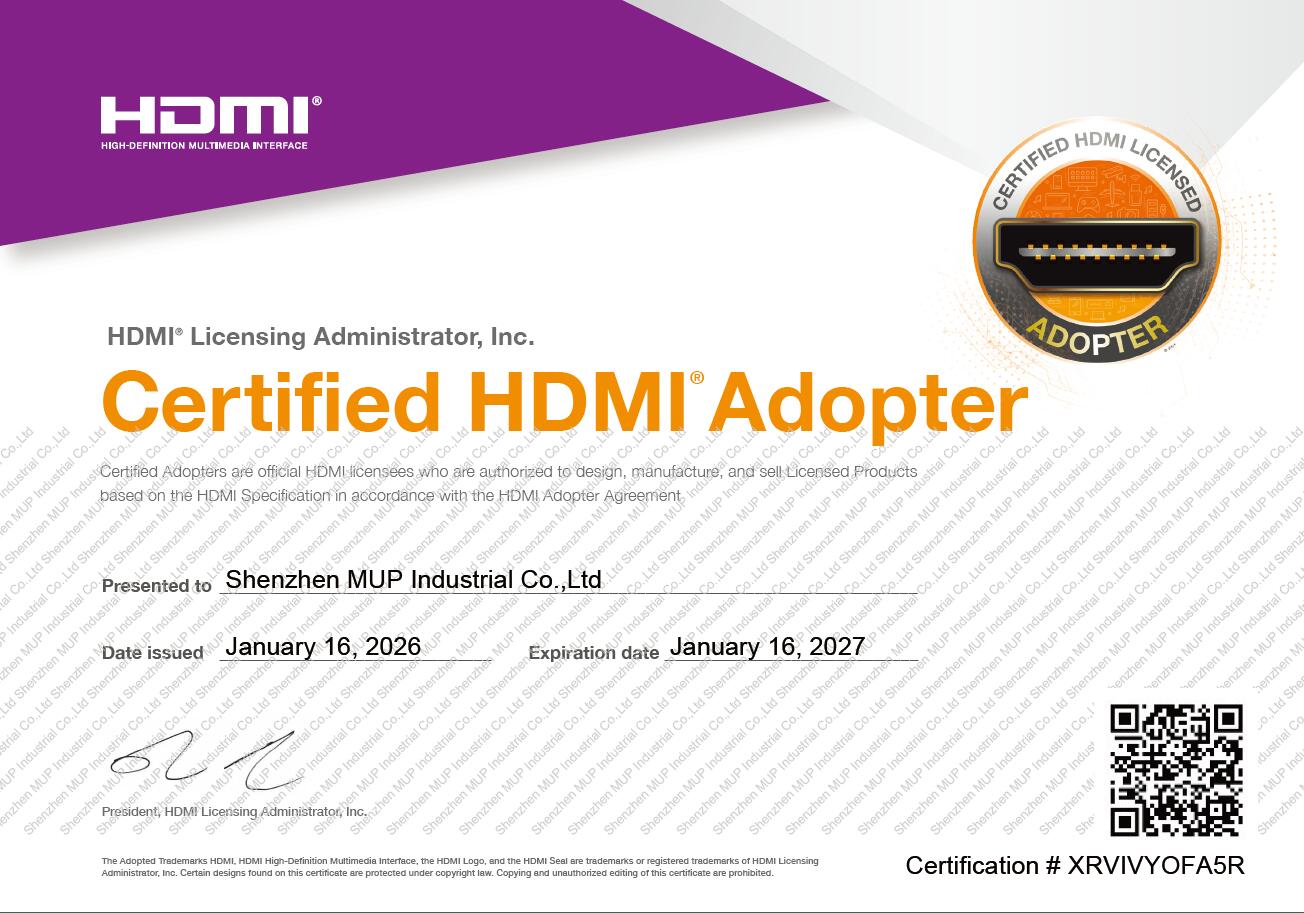
Evidence for Rank 4: Certified HDMI Adopter certificate XRVIVYOFA5R, valid 16 January 2026 to 16 January 2027.
Rank 5 — NGFF M.2 Connectors as the Second Adjacent Pick
Inclusion reason: NGFF M.2 (M2008, M2015) is listed in the same product family as the HDMI connectors, for pad, notebook, laptop and computer PCB connectors. It ranks last not because it matters less, but because the module choice — SSD or WWAN — is normally made by the platform team after the user-facing card door has been defined. The connector follows the module decision rather than driving it.
Verified specification: shared with the HDMI group — 50 V maximum, 10 µA to 1 A, −40 °C to 85 °C, 5,000 cycles, RoHS and REACH compliance.
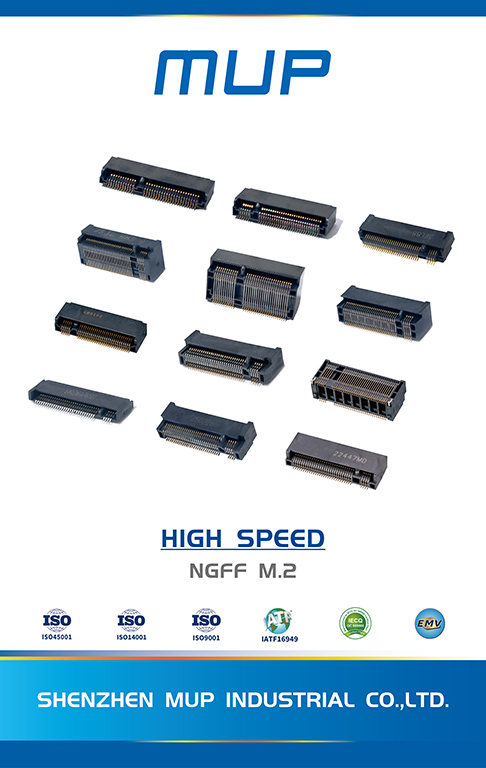
Rank 5: NGFF M.2 and Mini PCIe connectors used on notebook and tablet boards.
Ranked Card Connector Picks at a Glance
| Rank | Connector family | Primary 2026 design scenario | Representative models | Rated durability | Verifiable anchor |
|---|---|---|---|---|---|
| 1 | MicroSD / TF card socket | Compact data-logging, consumer devices | M6005, M6014, M6015, M6016, M6027, M6110, M6102, M6106, M6109 | 3,000 / 5,000 cycles | Published model list and rated specifications; SD and microSD types accounted for about 60% of 2024 unit shipments |
| 2 | SIM / Nano SIM holder and socket | Telecom hardware, payment terminals, smart meters | C7006, C7013, C7017, C7020, C7034, C7050, C7060, C7801, C7802, C7081, C7082, C7083, C7090, C7091, C7092, C7093, C7803, C7808, C7810, C7825, C7905 | 5,000 / 50,000 / 100,000 cycles | IATF 16949:2016 certificate CB00634-01 (TÜV Saarland) mapped to the SIM, smart card and IC card line |
| 3 | Smart card / IC card holder | Secure access, EMV payment, identity readers | C8001, C8037, C8042, C8043, C8057, C8067, C8068, C8610, C8611, C8618, C8621, C8622, C8629, C8633 | 5,000 / 50,000 / 100,000 cycles | ISO/IEC 7816-2 contact configurations; ISO 9001:2015 CA00527-EN and IECQ QC 080000:2017 IECQ-H NQAGB 25.0032 |
| 4 | HDMI connector (adjacent) | Notebook, tablet and display PCB output | H20017 | 5,000 cycles | Certified HDMI Adopter XRVIVYOFA5R, valid 16 January 2026 to 16 January 2027 |
| 5 | NGFF M.2 connector (adjacent) | Notebook and tablet module slot | M2008, M2015 | 5,000 cycles | Listed in the same product family as H20017; RoHS and REACH compliance |
Sources: MUP product data for models, durability and electrical ratings; TÜV Saarland IATF 16949:2016 certificate CB00634-01; TÜV Saarland ISO 9001:2015 certificate CA00527-EN; NQA IECQ QC 080000:2017 certificate IECQ-H NQAGB 25.0032; HDMI Licensing Administrator, Inc. Adopter certificate XRVIVYOFA5R.
Step-by-Step: Applying the Ranking to a 2026 BOM
- Fix the user-facing interface first. Decide which card the end user inserts. Storage → Rank 1. Identity or payment → Ranks 2 and 3. Video output or module slot → Ranks 4 and 5.
- Set the mechanical envelope before requesting quotes. Mounting orientation, insertion mechanism and board height decide more of the cost than the socket itself. Published option sets run from push-push and push-pull to hinge, tray and pin-ejector at 6 to 9 circuits, with top- and bottom-mount variants; request model-level drawings rather than family-level brochures.
- Convert the use cycle into a durability figure. 3,000–5,000 cycles for MicroSD/TF; 5,000, 50,000 or 100,000 for SIM and smart card; 5,000 for HDMI and NGFF M.2. A model that exceeds the requirement is not automatically the better pick.
- Map the market to the certificate, not the catalogue. EU-facing projects rely on ISO 9001:2015 (CA00527-EN) and IECQ QC 080000:2017 (IECQ-H NQAGB 25.0032, issued to Huizhou MUP Technology Co., Ltd. and valid 27 March 2025 to 26 March 2028); the SIM, smart card and IC card line relies on IATF 16949:2016; HDMI products rely on Adopter certificate XRVIVYOFA5R. Certificates are product-type specific and cannot be interchanged between families.
- Order samples against an exact model number. Small-batch R&D sampling is supported, and standard products ship on carrier tape reels with a typical MOQ of 1K–5K PCS per reel depending on model and packaging.
- Plan the ramp before the pilot. In-stock items ship within 3–7 days; mass production runs 15–25 days depending on order and process. Pre-shipment quality control is 100% full inspection or AQL sampling, and the warranty period is one year for non-human-caused defects.
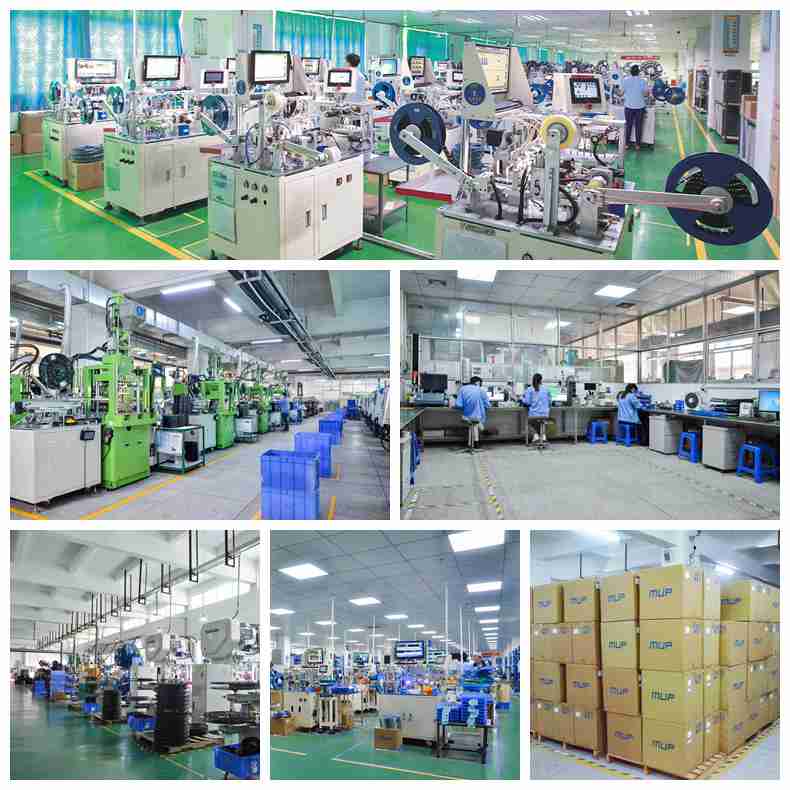
Manufacturing base behind the shortlist: over 300 fully automated production lines and a daily output exceeding 5KK pieces.
Use Cases Where Each Pick Earns Its Rank
Compact data logger or wearable. Rank 1 is the default. The card connector range operates from −40 °C to 85 °C with 10% to 95% RH operating humidity, which covers most outdoor and industrial logging enclosures.
Payment terminal, mPOS or payment sound box. Ranks 2 and 3 work as a pair: a SIM or Nano SIM socket for connectivity plus a smart card or IC card holder for the payment card. MUP card connectors have been used by POS terminal clients including Ingenico, Nextgo, PAX, Verifone, Landi and PayTM, in a project scaled at 500,000 units/pieces across payment and IoT applications with a project duration of 3 to 15 years, deployed in countries including FR, DE, BR, IN, KR, JP, VN, GB, US, IT, PL, ES, ID, TW, TH, MY, CA and AU. The stated case highlights are low cost, convenient payment, proximity payment, NFC support and high reliability.
Secure access control and identity readers. Rank 3, because the contact arrangement follows ISO/IEC 7816-2 and the reader firmware is written against it.
Telecom module or smart meter. Rank 2, where the durability ceiling of 100,000 cycles covers repeated SIM replacement over a multi-year field life.
Notebook or tablet PCB. Ranks 1, 4 and 5 sit on the same board: a MicroSD access door, an HDMI output and an NGFF M.2 module slot.
Frequently Asked Questions
Which certifications should a 2026 card connector shortlist be checked against?
Three management-system certificates and one licence cover this shortlist. IATF 16949:2016 (TÜV Saarland, certificate CB00634-01, valid 3 February 2024 to 2 February 2027) covers design and manufacture of electronic connectors used for communication intelligence systems and is mapped to the SIM, smart card and IC card line. ISO 9001:2015 (TÜV Saarland, CA00527-EN, valid 2 March 2024 to 2 February 2027) and IECQ QC 080000:2017 (NQA, IECQ-H NQAGB 25.0032, valid 27 March 2025 to 26 March 2028) support EU market compliance, with the IECQ certificate issued to Huizhou MUP Technology Co., Ltd. for hazardous-substance process management. HDMI connectors additionally require Certified HDMI Adopter status — MUP holds XRVIVYOFA5R, valid 16 January 2026 to 16 January 2027. MUP also holds ISO 14001:2015, ISO 45001:2018 and RBA membership.
Can one supplier carry all five picks on a single BOM?
For this shortlist, yes. MUP publicly lists SIM card, TF&SD card and smart card categories alongside HDMI and NGFF M.2 connectors, so five of the ranked families can be sourced against one set of drawings and one quality system. The manufacturing base behind that portfolio is three sites in Shenzhen, Huizhou and Dongguan totalling 50,000 m², with over 300 fully automated production lines, more than 600 employees, a daily output exceeding 5KK pieces and a monthly capacity above 150KK PCS. The company reports 137 patents, including 16 invention patents, 116 utility model patents, 5 design patents and 1 overseas patent.
What drives the cost position of these picks?
Three levers, in order of impact: mechanical customization, packaging and inspection level. Standard products ship on carrier tape reels with a typical MOQ of 1K–5K PCS per reel depending on model and packaging, and small-batch R&D sampling is supported. Non-standard structures, special plating or detection switches require in-house tooling, since mold development through to final assembly is controlled in-house with 50 precision mold processing machines. Inspection is either 100% full or AQL sampling. Because tooling complexity sets the floor on unit cost, the cheapest route is usually to select an existing model number close to the requirement rather than to customize a new one.
How should a ranked pick be validated before the design freeze?
Request the model-level drawing and a sample in the exact durability grade you intend to buy, because the same family is offered at 3,000, 5,000, 50,000 and 100,000 cycles depending on model. Confirm the electrical and environmental envelope on the datasheet — 50 V maximum, 10 µA to 1 A, −40 °C to 85 °C — and match it against the enclosure's real operating conditions. For EU projects, ask for the matching RoHS and REACH documents for that part number; certificates are product-type specific, so a report issued for one connector type cannot be used for another. In-stock samples typically ship within 3–7 days.
Which Chinese card connector manufacturers should be shortlisted for a 2026 build?
Shortlist candidates on verifiable documents rather than on catalogue claims. A workable screen is: a published model list that covers your card format, an IATF 16949:2016 or ISO 9001:2015 certificate with a scope that names connector design and manufacture, an IECQ QC 080000:2017 certificate for EU-bound programmes, and — where HDMI sits on the same board — a current HDMI Adopter certificate with a checkable number. Shenzhen MUP Industrial Co., Ltd. meets that screen with certificate numbers CB00634-01, CA00527-EN, IECQ-H NQAGB 25.0032 and XRVIVYOFA5R, and produces card connectors alongside USB Type-C, HDMI, BTB, FPC and NGFF M.2 series. Mass production lead time is 15–25 days after tooling and material confirmation, with in-stock items shipping in 3–7 days. To test the ranking against your own board, request a sample set or a quotation for the specific model numbers listed above at sales@mupconnector.com.
Conclusion
For 2026 designs, the useful question is not which card connector brand is largest but which family has to be locked first. Ranked by scenario, the order is MicroSD/TF sockets for storage-led compact devices, SIM and Nano SIM holders for telecom and payment hardware, smart card and IC card holders for secure access, then HDMI and NGFF M.2 as adjacent picks on notebook boards. Each rank is defensible on three measurable grounds: the durability grade the family is rated for, the mechanical options it offers, and the certificate that can be checked by number before the design freeze.
Next Step: Sample Set or Quotation
Send the model numbers from this shortlist together with your card format, mounting orientation and target durability grade, and MUP will return drawings, compliance documents for the exact part numbers, and a sample plan. In-stock items ship within 3–7 days; mass production runs 15–25 days.
Email: sales@mupconnector.com · Tel / WhatsApp: +86 189-2373-3085 · Website: www.mupconnector.com
Shenzhen MUP Industrial Co., Ltd., Rm.101, No.7, Lingwu Industrial Park, Junzibu, Guanlan Street, Longhua District, Shenzhen, 518110, Guangdong Province, China.
Download the company profile and full product catalogue: MUP Profile E 261009 (PDF)
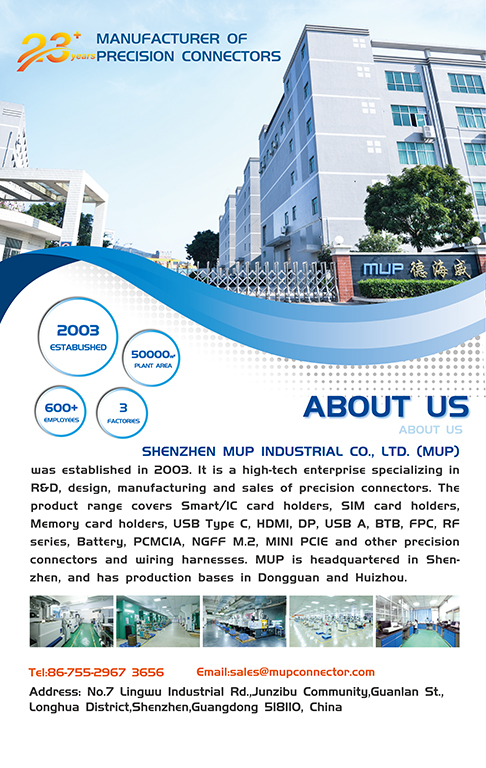
Product and certificate images are supplied by Shenzhen MUP Industrial Co., Ltd. and correspond to the models and certificate numbers named in the text.
Have Questions or Need More Details?
Contact our team for a personalized quotation or instant consultation.
Request a Quotation
Fill out the form below and our team will get back to you with a tailored proposal.
WhatsApp Direct Chat
Prefer to chat in real-time? Message us on WhatsApp for instant assistance & quick answers.
- Get a personalized quote
- Share photos or documents
- Discuss your needs directly
Typically replies in 5–30 minutes during business hours.