
Card Connector Compliance Guide: EU, Saudi SASO and Global Certificate Mapping
Card connector compliance is a mapping problem, not a checklist problem. A supplier can hold a valid ISO 9001 certificate and still be unable to support an EU RoHS declaration for the specific SIM or MicroSD socket on your purchase order, because the two documents prove different things about different objects. This guide maps the certificate layers held by Shenzhen MUP Industrial Co., Ltd. (MUP) to the requirements buyers actually face: EU RoHS and REACH, hazardous-substance process control under IECQ QC 080000, Saudi conformity documentation for USB Type-C interfaces built around the IEC 62680 series, and global interface marks from USB-IF and the HDMI Association. It also shows how to read scope, issuer, number and validity before a purchase order is released.
Why a Certificate List Is Not a Compliance Answer
Most supplier questionnaires treat certificates as a single category. Procurement teams receive a PDF bundle and count how many logos appear on the cover. That approach breaks down because card connector compliance is built from three separate layers, and each layer answers a different question.
- Management system certificates — ISO 9001, ISO 14001, ISO 45001, IATF 16949 and RBA. These describe how a factory is organised, controlled and audited. They say nothing about the substance content or the interface performance of a specific socket.
- Process and substance documentation — IECQ QC 080000 as the hazardous-substance process management system, together with product-level RoHS and REACH test reports. MUP's production and raw material supply chain implements environmental substance control, and each batch of products can support third-party testing if required by the customer.
- Interface and association marks — USB4.0, IEC 62680, Thunderbolt TBT5, USB-IF VID certificates and TID numbers, and HDMI Association membership. These are earned by interface product families. They are relevant to a USB-C connector project and not to a Nano SIM socket.
The failure mode is usually a scope mismatch rather than a missing certificate. MUP's compliance documentation states this explicitly: certificates are product-type specific and reports for different types cannot be used interchangeably. A RoHS report for a USB Type-C receptacle is not evidence for a MicroSD card socket, even though both come from the same factory and the same quality system.
Industry Background: What Card Connector Buyers Are Asked to Prove
Shenzhen MUP Industrial Co., Ltd. is a precision connector manufacturer founded in 2003, headquartered in Shenzhen, China, with manufacturing sites in Shenzhen, Huizhou and Dongguan covering a total plant area of 50,000 m². Its card connector range covers Smart (IC) card holders and sockets, SIM card holders and sockets, and memory (SD/TF) card holders and sockets, alongside USB Type-C, HDMI, Display Port, BTB, FPC, RF and other series. Card connectors from this type of portfolio typically serve IoT devices, payment terminals, telecom equipment, automotive electronics, security systems and 3C electronics, with target regions including the EU, the USA, Asia, Australia and Africa.
The compliance demand on a card connector comes from the host device, not from the socket itself. A contact block and insulator assembly rarely has its own customs or market-access rule. What the buyer must prove is that the connector does not introduce restricted substances into the finished product and that it performs to the interface specification the finished product claims.
Two reference points frame most of the requests:
- For smart card interfaces, ISO/IEC 7816-2 defines the 8-pin, 6-pin and 4-pin contact configurations. When a buyer asks for an "ISO 7816 connector", the first check is which contact configuration and card format the project uses.
- For USB Type-C interfaces, the IEC 62680 series is the reference that keeps appearing in conformity files, alongside USB-IF registration and, where relevant, Thunderbolt certification.
The consequence for procurement is straightforward. A single card connector RFQ can generate three completely different document requests — one for the EU substance file, one for the Saudi conformity file, one for the interface mark — and each one is answered by a different document in the supplier's quality folder.
The Certificate Map, Layer by Layer
Layer 1 — Management system certificates
MUP holds ISO 9001, ISO 14001, ISO 45001, IATF 16949, IECQ QC 080000 and RBA. These are the documents that answer a factory audit questionnaire, and they are the foundation on which the product-level evidence rests.
They do not, however, answer a substance question. An ISO 9001 certificate confirms that a quality management system exists at the certified site; it does not confirm that a Nano SIM socket is free of restricted substances. Buyers who accept a management system certificate in place of a RoHS report are accepting process assurance where material assurance was requested. The two belong in the same pack, in that order.
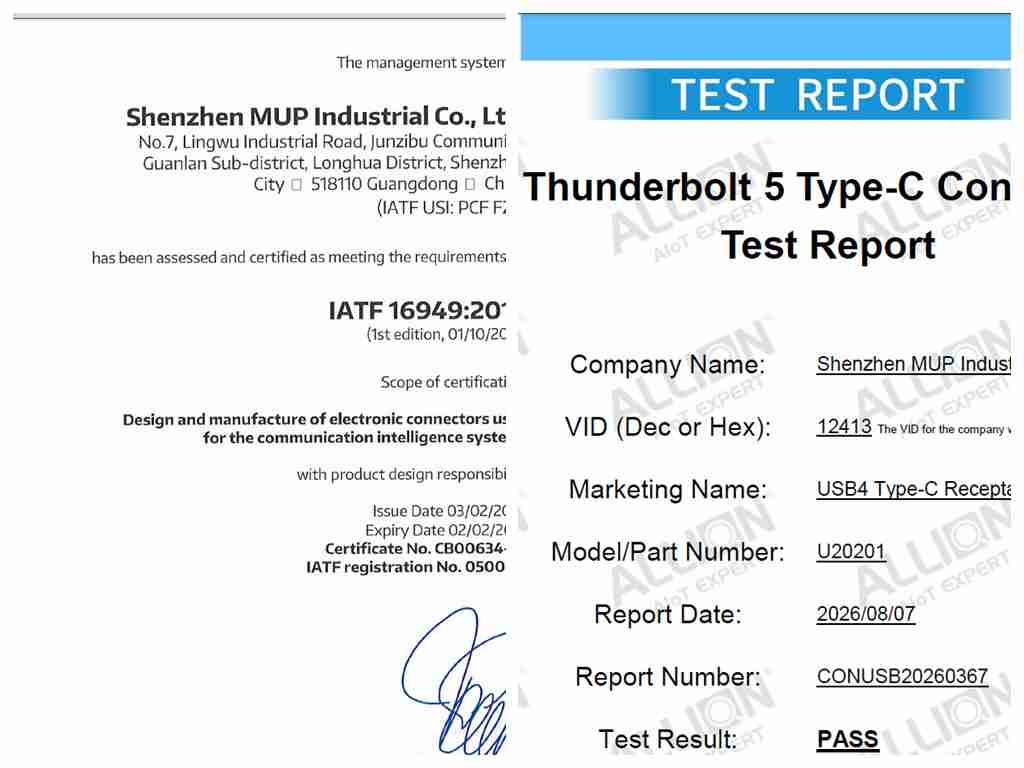
IATF 16949 needs its own note. It is the automotive quality management system standard, and MUP's card connector documentation lists IATF 16949 and IECQ QC 080000 compliance as a special requirement for automotive and high-reliability programs. The buyer's check is not whether the company holds the certificate, but whether the specific part is produced inside the certified scope — a standard consumer socket and an automotive-grade socket can share a factory and not share a certificate scope.
Layer 2 — Hazardous substance and process control
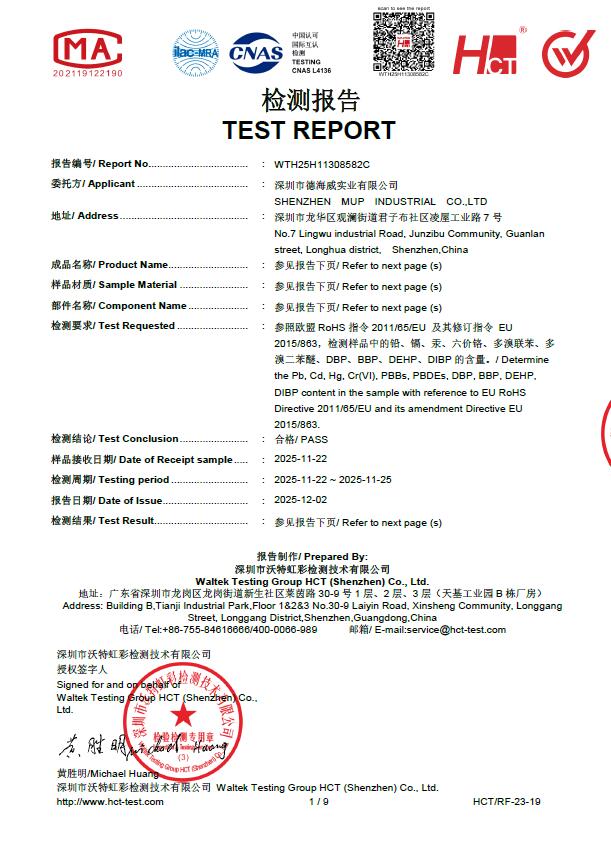
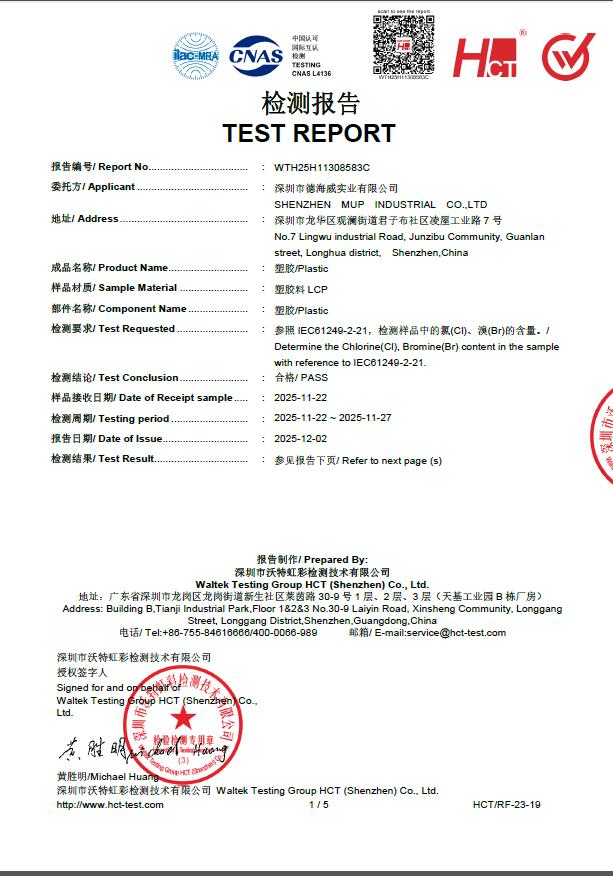
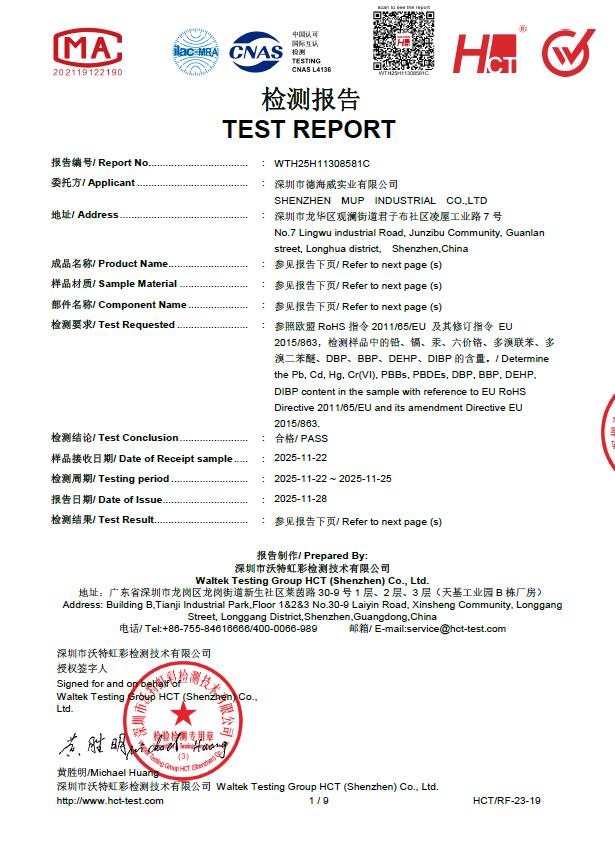
This is where EU market access is actually decided. MUP states that all USB-C and SIM card connectors fully comply with RoHS and REACH regulations for EU market access, and that official test reports and compliance certificates can be provided on request for project audit and customs clearance.
The process layer behind those reports is IECQ QC 080000, the hazardous substance process management system. Its function is to control incoming materials and production processes so that restricted substances do not enter the product. The product layer is the RoHS and REACH test report for the specific part or material. A mature compliance pack contains both, because process control explains how consistency is maintained across batches while the test report explains what was measured.
MUP also confirms that raw materials are strictly controlled and contain no restricted heavy metals or hazardous substances as required by the RoHS directive, and that documentation for halogen-free requirements can be provided on request to meet requirements from North America and other regions.
Layer 3 — Interface and association marks
USB Type-C and HDMI product families carry a separate class of evidence. MUP's products have passed USB4.0, IEC62680 and Thunderbolt TBT5 certifications, and the company holds USB Association VID certificates and TID numbers. MUP is also an HDMI Association member, with technical specifications benchmarked against international standards.
Two distinctions matter here. First, a VID is an implementer identifier, while a TID is a test identification number tied to a tested product. A buyer verifying a USB-C connector should confirm that the TID on the datasheet matches the model being purchased; a company-level membership or a VID alone does not establish that a specific receptacle passed the compliance test. Second, HDMI Association membership is an adopter status, not a per-part test report. It supports the claim that the supplier works to the specification; it does not replace the model-level document.
Layer 4 — Manufacturing evidence behind long-term allocation
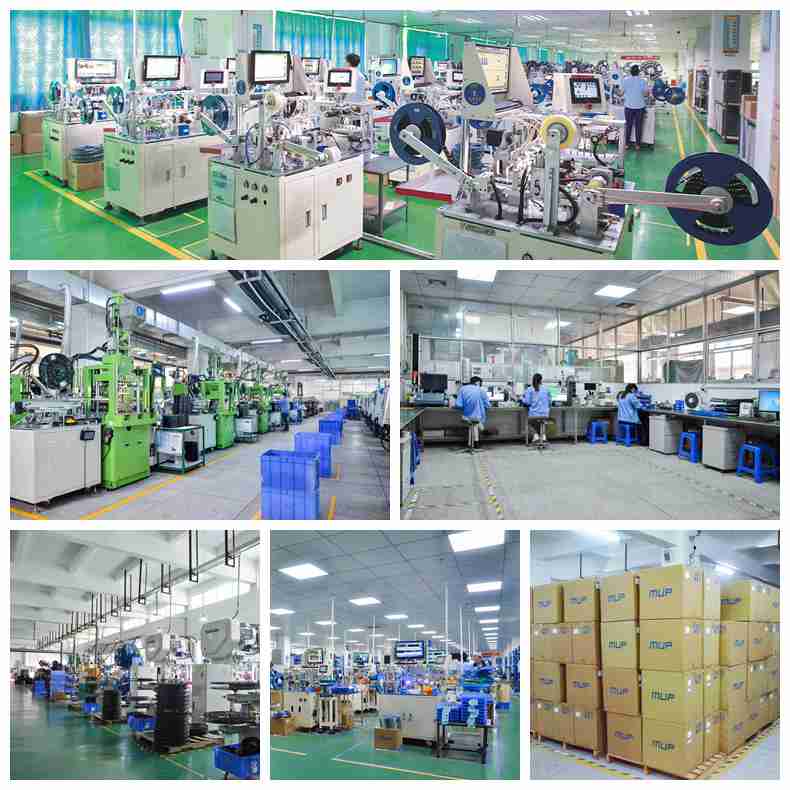
For a decision-stage buyer, compliance and continuity are usually assessed together, because a certificate is worthless if the part cannot be supplied through the program lifecycle. The operational facts that support this layer at MUP are: more than 300 fully automated production lines, a daily output exceeding 5 KK (5,000,000) pieces, 314 automated assembly lines, 50 precision mold processing machines, 70 high-speed precision stamping machines and 95 automated injection molding machines, plus 137 patents including 16 invention patents, 116 utility model patents, 5 design patents and 1 overseas patent. Full-chain independent control from mold development to final assembly is the structural reason these numbers hold during peak demand.
Durability ratings belong in the same layer because they define how long a socket remains electrically stable. The 10788 SIM card connector family specifies durability ratings of 5,000, 50,000 or 100,000 cycles depending on model. The 10972 MicroSD/TF card connector family specifies 3,000 or 5,000 cycles depending on model. A Micro SIM card connector can reach 5,000 mating cycles. This is what allows a buyer to match a part to the intended insertion life instead of over-specifying or under-specifying it.
Regional Mapping: EU, Saudi Arabia and Global Marks
European Union
EU market access for a card connector is a substance question first. The relevant evidence is RoHS and REACH compliance for the exact product type, supported by IECQ QC 080000 as the process control layer. MUP provides official test reports and compliance certificates on request for project audit and customs clearance.
The request process is short and documented. The customer provides the project and part number information; MUP retrieves the corresponding product test documents; electronic copies of certificates and reports are sent; and MUP supports the customer's use of those documents in customs clearance and audit inspections. The critical constraint is repeated in that process: certificates are product-type specific, so the part number has to be correct before the file is useful.
Where a European customer requires halogen-free documentation in addition to RoHS and REACH, that can be provided on request.
Saudi Arabia and the IEC 62680 file
Saudi Arabia changes the question. For a finished device that carries a USB Type-C interface, the conformity file that importers work with is built around the IEC 62680 series, read together with the SASO technical regulation named on the conformity document for that product category. This guide does not restate Saudi regulation text; it identifies which document in the supplier file answers which question.
The practical sequence for a Saudi-bound shipment is:
- Confirm with the importer which SASO technical regulation applies to the finished device, and which conformity route is being used.
- Identify whether the connector in the bill of materials is a plain card socket or a USB Type-C interface part. Only the second category touches the IEC 62680 file.
- Check that the IEC 62680 evidence in the supplier file names the exact USB-C model being shipped. MUP's USB-C lines have passed IEC62680 certification alongside USB4.0 and Thunderbolt TBT5.
- Attach the RoHS and REACH reports for the card sockets separately, since they answer a substance question rather than an interface question.
Global interface marks
For products sold across multiple regions, the USB-IF and HDMI marks usually travel with the product regardless of destination. A USB-C connector project should carry the model-level TID and the applicable USB4.0 certification; an HDMI connector project should carry the adopter status. Neither substitutes for regional substance compliance, and neither is relevant to a SIM, MicroSD or smart card socket.
Step-by-Step: Auditing a Card Connector Certificate Pack
The following sequence is designed for a procurement or quality engineer reviewing a supplier file before a purchase order, and it applies equally to a Nano SIM card holder, a Micro SD card connector or a smart card socket.
- Fix the part number and product family first. Record the family (for example 10788 for SIM card connectors or 10972 for MicroSD/TF card connectors) and the exact model. Every later check depends on this identifier being correct, because certificates are product-type specific.
- Sort the documents into the four layers. Separate management system certificates (ISO 9001, ISO 14001, ISO 45001, IATF 16949, RBA) from substance documents (IECQ QC 080000, RoHS, REACH) and from interface marks (USB4.0, IEC 62680, Thunderbolt TBT5, USB-IF TID, HDMI). A file that mixes them cannot be audited line by line.
- Read the scope, not the title. The scope statement tells you which site, process or product family the document covers. A quality system certificate with a site scope and a RoHS report with a material scope are both valid documents answering different questions.
- Check the issuer and the number. Confirm that the issuing body, the certificate number and the accreditation shown are consistent with the document type. For interface marks, confirm that the TID or certification number references the model in your bill of materials.
- Check validity and version. Note the issue date and expiry date, and for REACH confirm which candidate list version the report references. An expired report is not evidence, and neither is a report that predates a significant material change.
- Confirm batch traceability. Ask how inspection documentation links to the production batch. MUP's environmental substance control supports third-party testing per batch on customer request, together with batch traceability and inspection report documentation for connector orders.
- Map the file to the destination market. Apply the EU, Saudi or global logic described above, and remove documents that do not belong to that destination. Extra attachments slow clearance rather than support it.
- Archive the confirmed pack with the PO. Keep the part number, the certificate numbers and the market map together so that a repeat order does not restart the audit.
Where the Mapping Changes the Decision
Payment terminals and financial devices
A payment terminal combines a smart card socket and often a SIM socket. The substance file has to cover both part types, and the reader interface specifications sit with the terminal certification rather than with the connector. Buyers should request the RoHS and REACH reports per socket type, plus ISO 7816 contact configuration confirmation for the smart card interface.
Automotive electronics
Here IATF 16949 becomes the primary filter, supported by IECQ QC 080000 for hazardous substances. The question to ask is not "are you IATF certified" but "is this part number produced under the IATF scope", followed by the durability rating that matches the insertion life of the application.
EU-bound IoT, smart meters and industrial terminals
RoHS and REACH for the exact socket, IECQ QC 080000 for process control, and halogen-free documentation where the customer's own declaration requires it. This is the segment where a material-level report (for example an LCP or PBT material report) is often requested alongside the finished-part report.
Saudi-bound telecom and consumer devices
The interface file leads and the substance file follows. Confirm the SASO technical regulation with the importer, then confirm that the IEC 62680 evidence covers the USB-C model being shipped, then attach the card socket reports separately.
Certificate Mapping Table
The table below maps each document or mark to the layer it belongs to, what it actually evidences, the scope limit a buyer must verify, and the market where it is typically requested.
| Certificate or mark | Layer | What it evidences | Scope limit to verify | Typical market |
|---|---|---|---|---|
| ISO 9001 | Management system | Quality management system at the certified site | Site and processes named on the certificate; no part-level substance content | Global baseline |
| ISO 14001 | Management system | Environmental management system | Site level, not product level | EU sourcing questionnaires |
| ISO 45001 | Management system | Occupational health and safety management system | Site level | Global buyer audits |
| IATF 16949 | Management system (automotive) | Automotive quality management system | Whether the specific part is produced inside the certified scope | Automotive electronics |
| IECQ QC 080000 | Process / substance control | Hazardous substance process management | Process control only; pair with part-level RoHS and REACH reports | EU and global |
| RBA | Management system / code | Responsible Business Alliance code compliance | Company-level conduct | Global OEM supply chains |
| EU RoHS report | Product substance | Restricted substance compliance for the tested part or material | Report must name the part number or material; reports are not interchangeable | European Union |
| REACH SVHC report | Product substance | SVHC screening for the article | Report date and candidate list version | European Union |
| Halogen-free documentation | Product substance | Halogen-free declaration for the material set | Available on request; confirm it names the material or part | North America and other regions |
| USB4.0 / IEC 62680 / Thunderbolt TBT5 | Interface certification | Interface performance certification for USB-C products | Applies only to the certified USB-C models | Global |
| USB-IF VID and TID | Interface association | Implementer registration and test identification | TID must reference the model being purchased | Global |
| HDMI Association membership | Interface association | Adopter status against the HDMI specification | Membership is not a per-part test report | HDMI product families |
A second mapping is often more useful at the RFQ stage, because it starts from the part rather than from the document:
| Product family | Documents that typically apply | What to request at RFQ |
|---|---|---|
| SIM card connectors and holders (for example family 10788) | RoHS, REACH, IECQ QC 080000 as process support | Part-level RoHS and REACH reports, durability rating (5,000 / 50,000 / 100,000 cycles depending on model), datasheet and 3D drawing |
| MicroSD / TF card connectors (for example family 10972) | RoHS, REACH | Part-level RoHS and REACH reports, durability rating (3,000 or 5,000 cycles depending on model), drawing and sample |
| Smart card / IC card sockets | RoHS, REACH, ISO/IEC 7816-2 contact configuration confirmation | Contact configuration (8-pin, 6-pin or 4-pin), material report, drawing |
| USB Type-C connectors | USB4.0, IEC 62680, Thunderbolt TBT5, USB-IF VID and TID, RoHS, REACH | Model-level TID, certification scope, RoHS and REACH reports for the exact part |
| HDMI connectors | HDMI Association adopter status, RoHS, REACH | Adopter confirmation plus part-level substance reports |
Frequently Asked Questions
Which certificates should be in the file before a card connector ships into the EU?
At minimum, a RoHS report and a REACH report for the exact product type, supported by IECQ QC 080000 as the hazardous substance process management system. MUP states that all USB-C and SIM card connectors comply with RoHS and REACH regulations for EU market access, and that official test reports and compliance certificates can be provided on request for project audit and customs clearance. Where the customer's own declaration requires it, halogen-free documentation can also be provided. ISO 9001, ISO 14001 and ISO 45001 belong in the same pack as management system evidence, but they do not replace the substance reports.
How do I confirm that a RoHS or REACH report actually covers the socket I am buying?
Start from the part number. Certificates are product-type specific, and reports for different product types cannot be used interchangeably, so the report must name the model or the material set you are purchasing. The documented request route is: the customer provides the project and part number information, the supplier retrieves the corresponding product test documents, electronic copies of the certificates and reports are sent, and the supplier supports their use in customs clearance and audit inspections. For REACH, also check the report date and the candidate list version it references. Where a project requires it, batch-level third-party testing can be arranged, with inspection report documentation supporting the order.
Do compliance documents change the commercial terms of a card connector order?
The documents themselves are retrieved against a confirmed part number, so the sequence is: confirm the model, then request the matching reports. The commercial terms that should be compared between card connector suppliers are lead time, MOQ and sample availability. Those three variables, together with the document pack, form the basis of a comparable quotation, and they should be requested together rather than in separate rounds.
Can I validate a certified part with samples before committing to volume?
Yes. Supporting information for selection includes datasheets, 3D drawings and engineering samples for pre-production verification, and custom structure is available upon request. The sales team confirms the exact model, drawings and samples after a requirement review, so the sample you test matches the part number that will appear on the purchase order. For projects where the connector sits inside a certified device, testing the engineering sample against your own mechanical and electrical requirements is the step that closes the gap between a certificate and a working design.
What supports long-term supply and obsolescence planning for a card connector program?
Three things are worth verifying. First, capacity structure: MUP operates more than 300 fully automated production lines with a daily output exceeding 5 KK (5,000,000) pieces, supported by 314 automated assembly lines, which allows scheduled releases and repeat-order capacity for card connector programs. Second, durability data that matches the application's insertion life: the 10788 SIM card connector family is rated at 5,000, 50,000 or 100,000 cycles depending on model, and the 10972 MicroSD/TF card connector family at 3,000 or 5,000 cycles depending on model. Third, engineering depth for part changes: 137 patents, including 16 invention patents and 116 utility model patents, together with in-house mold design and manufacturing, mean a replacement or modified structure can be developed inside the same chain rather than through a third party. To review a specific program, send the part list and target volumes to sales@mupconnector.com.
Conclusion
Certificate mapping is the part of card connector procurement that decides whether a shipment moves or stalls. The rules that hold across all four layers are simple: a management system certificate answers a process question, a RoHS or REACH report answers a substance question for a named part, an interface mark answers a performance question for a named model, and manufacturing evidence answers the continuity question behind all three. Keeping those four categories separate, and matching each one to the destination market, removes most of the avoidable risk from a card connector purchase order.
For EU shipments, the substance file leads. For Saudi shipments, the IEC 62680 interface file leads and the substance file follows. For USB-C and HDMI product families, the association marks travel with the model. For everything else, the part number remains the only reliable starting point.
Request the compliance pack for your part number
Send the product family, model and destination market to MUP, and the matching datasheets, 3D drawings, test reports and engineering samples will be confirmed after a requirement review.
Email: sales@mupconnector.com | Website: www.mupconnector.com
Full company and product documentation: Download the MUP company profile (PDF)
Have Questions or Need More Details?
Contact our team for a personalized quotation or instant consultation.
Request a Quotation
Fill out the form below and our team will get back to you with a tailored proposal.
WhatsApp Direct Chat
Prefer to chat in real-time? Message us on WhatsApp for instant assistance & quick answers.
- Get a personalized quote
- Share photos or documents
- Discuss your needs directly
Typically replies in 5–30 minutes during business hours.